Blog

Metohi Vai Taverna

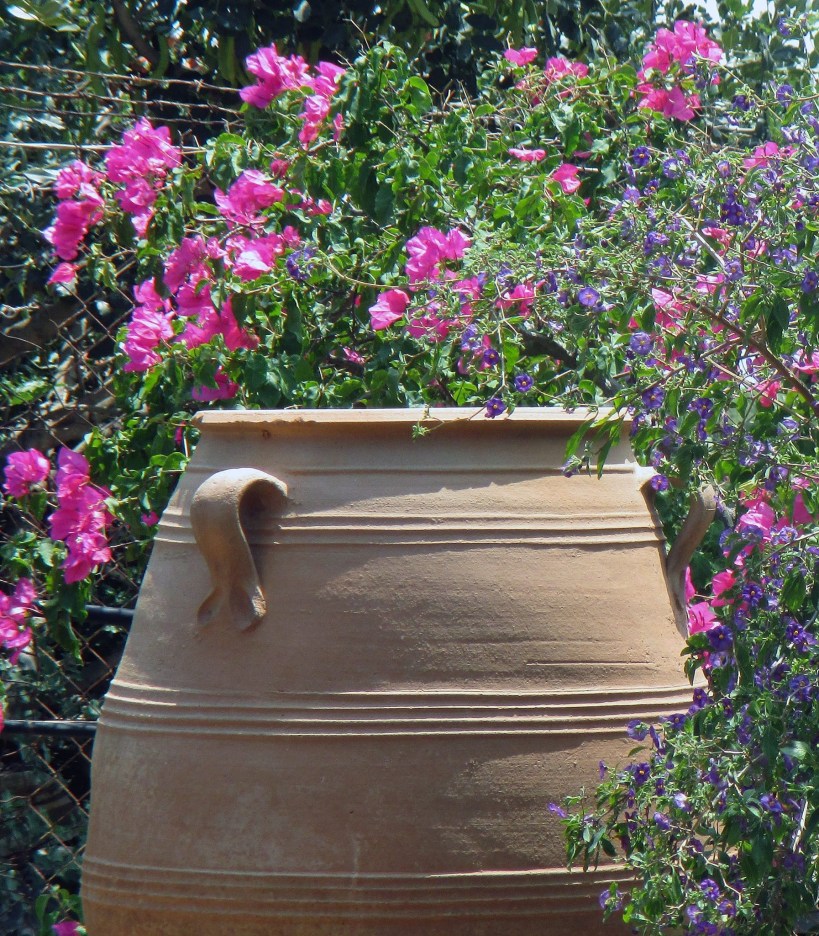
pithoi .jpg

Surrrounding the family run Metohi Vai Taverna are herb gardens buzzing with bees and giving off the aroma of the indigenous plants growing there. In any nook on the paved terrace are pithoi planted with colourful, fragrant blooms. These complement the brightly coloured water jugs and flowers that adorn the tables. Interesting works of art, lovingly nurtured from driftwood smoothed by the sea and washed up on the local beaches, sit on tables, and bits of traditional ironware adorn niches in the old stone walls.

Rushwork umbrellas provide welcome shade from the burning sun. Despite the heat it is difficult to resist the delicacies on offer. I order far too much. A horta omelette and salad is followed by pork shanks marinaded and roasted in red wine vinegar, lemon juice, garlic and oregano, served with traditionally roasted potatoes in lemon juice. For the connosieur a full red would have been the order of the day but the heat and generous portions lead us to an ice-cold light, fruity house white so sharp it could cut glass.
Chora Sfakion

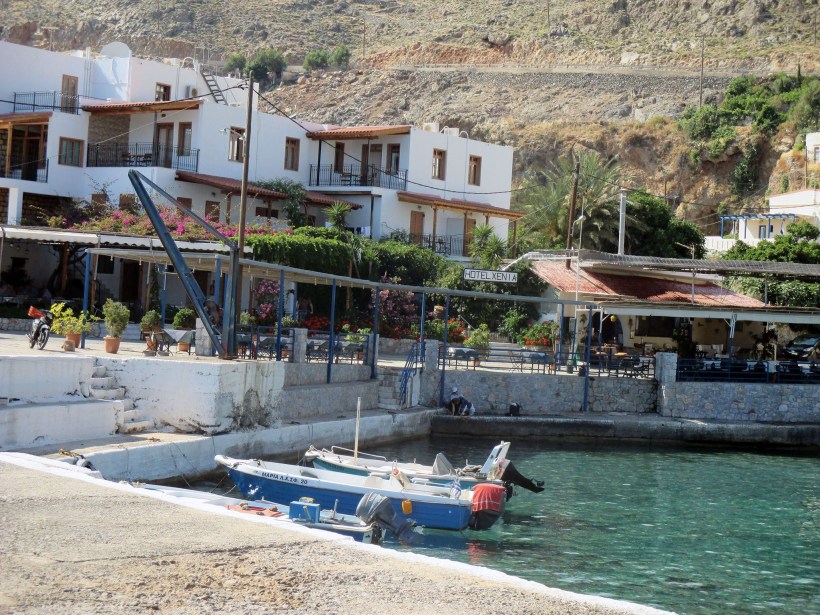
chora sfakion.jpg

It has been some 30 years since I was last here in Chora Sfakion, and in the mind’s eye little has changed. Although not true of parts of the northern coast of Crete, Sfakia, only tens of miles distant as the eagle flies, is a world away in essence. It is truly part of a hidden Crete, which makes travelling through this island’s mystical landscape such a serendipitous experience that it is impossible to exhaust.
Here we are perched on the edge of Europe. The isle of Gavdos, 25 miles due south, is the most southerly part of the continent. To the east on this same coast is Ierapetra, the most southern city in Europe. We are in border territory. Crete stands poised on the margins of Europe, Asia and Africa, an accident of the violent volcanic birth that endows this island with a cosmopolitan cultural legacy and a turbulent history.

Chapel on the hill

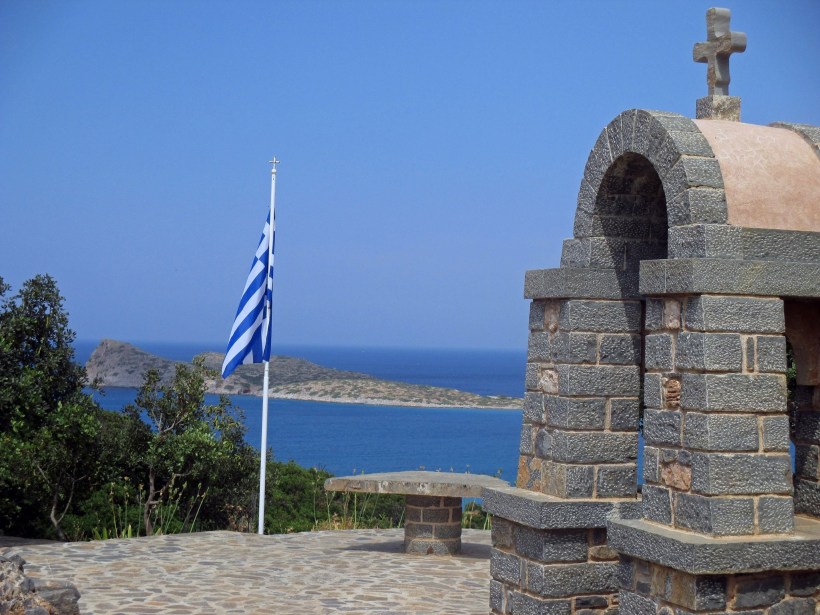
chapel on the hill .jpg

The land falls away to my right, rolling and tumbling downwards into the Gulf of Mirabello. As I look back I see a blue ketch at anchor off the luxury hotels to the south. Still further lies the headland announcing the entrance to the harbour of Agios Nikolaos. All around goat bells jingle, the sound the only betrayal to their well-camouflaged presence on the scrubby hills.
Near the summit a path leads to a small chapel flying the yellow and black banner of the Orthodox church alongside the Greek flag. The twin-headed eagle crowned with a mitre, clutching an orb and sword in its talons flaps in the hot breeze that caresses the stone courtyard. A battered motorbike stands outside the door. I look through the window and see an elderly man busying himself with housekeeping duties.
This is the chapel of Agios Loukas, which was rebuilt between 1996 and 2002 on the site of the ruins of a 13th-century church of the same name. Until then, it had been used to pen sheep and goats. To the east I glimpse the island of Kolokithia lying offshore. I can orientate it accurately as, like most Greek Orthodox churches, Agios Loukas is build along an east west line, with the church door facing west so as the congregation enters they move towards the enlightenment of the east. This is worth remembering as it is a good way of navigating if you get lost, as a chapel or church is never far away on Crete.

Elounda’s mermaid

elounda canal .jpg

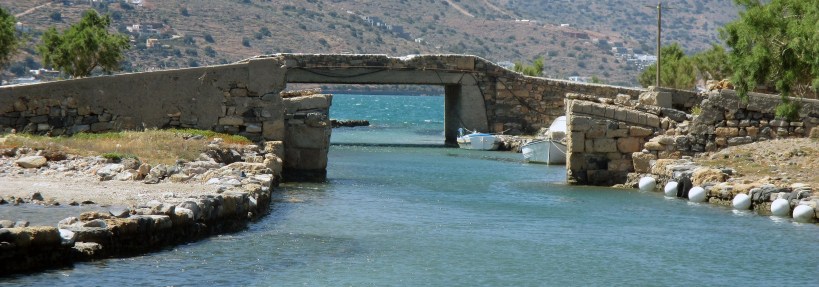
Legend has it that the lagoon itself is the domain of the mermaid goddess, Britomartis, whose likeness is to be found replicated on souvenirs throughout Crete. There are many myths surrounding Britomartis, and the details of her story may have been changed many times over thousands of years. What is certain is that her image is found on coins that were discovered beneath the waters in the submerged city of Olous.
The most popular version of her story around these parts is that she was the daughter of Zeus and Carme. A nymph whose name means sweet maiden, she was born in Gortys on the island and was the Minoan goddess of hunting and the mountains. So alluring was she that King Minos himself became obsessed with her beauty and pursued her. To protect her honour and escape the randy monarch, she threw herself into the sea and became entangled in some nets set by local fishermen. They rescued her and ever since, as an act of gratitude, she has become the protector of seafarers.

The streets of Lindos

Lindos door .jpg

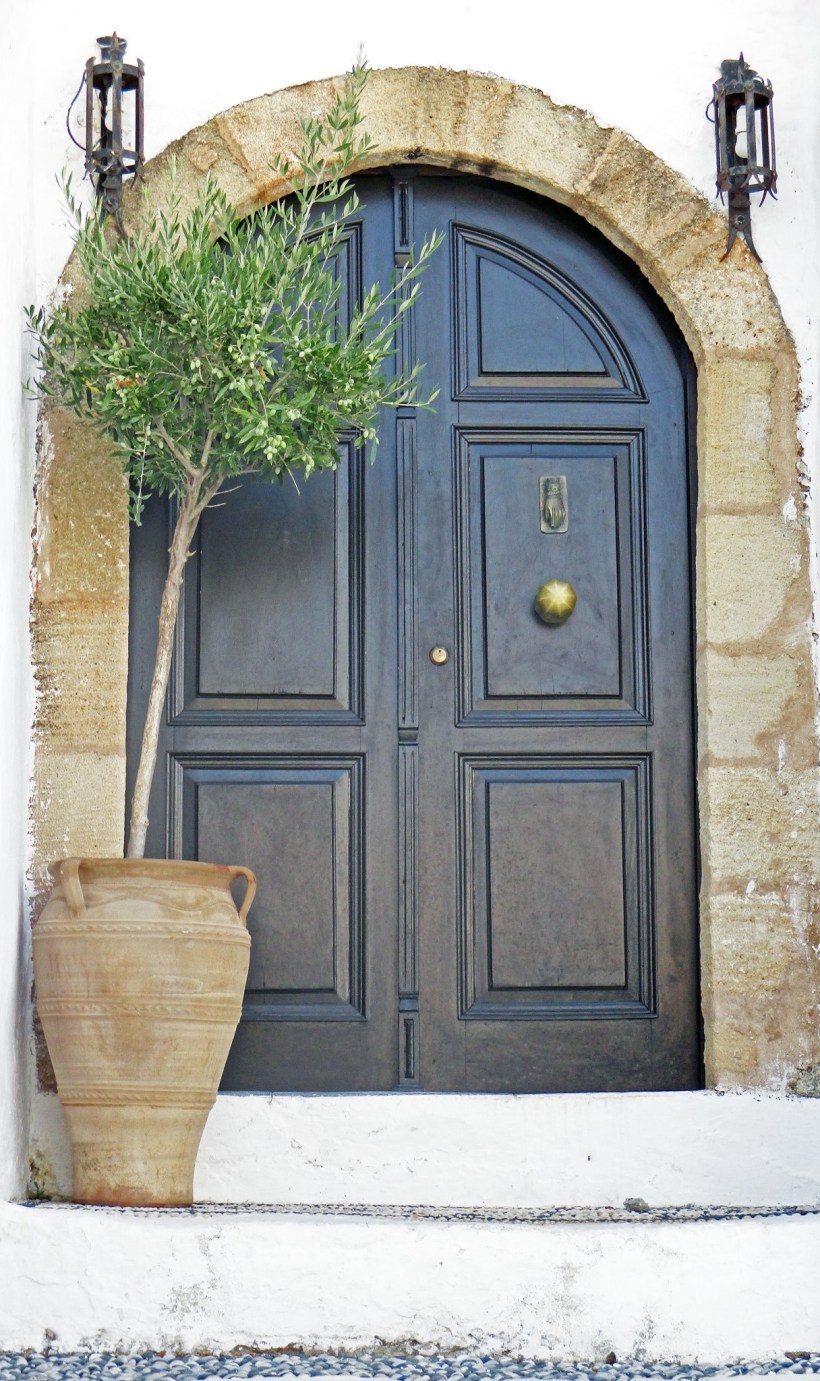
Heavy bare-wood doors, dressed in uncompromising black ironmongery, stand open to reveal the mosaic chochlakia floors of a thousand courtyards. These intricately laid black and white beach pebbles set in symmetrical shapes that allude to Lindos’ maritime past or even just to the aesthetic whim of a master craftsman are said to massage the bare-footed stroller in much the same way as pressure points in acupuncture or chiropody. Whether this is true or not, they provide a striking location for families to eat, drink and siesta as cats doze in the shade of potted pink, purple, red and yellow hibiscus, barely opening one eye to the swallows busying themselves building nests in the gnarled old beams above.

Potamon Dam

potamon dam .jpg

Befitting this splendid location looking down on the lake, the chapel itself was pristine, belying the unkempt nature of this little churchyard surrounded by a rusting wire fence. We try the door and it is open. The light rushes in to fill in the shadows, reflecting off an array of tama hanging on ribbons from hooks and poles near the icons on the walls.
Tamata are small metal plaques, most made of tin but some of more precious metals. Embossed on these are images of feet, hearts, eyes and wedding crowns. Symbolic of any condition or other subject of prayer, the tamata are votive offerings. Frequently seen in Greek Orthodox churches they are offered up as a reminder to the saints of the plight of the faithful, or as a thank you for being blessed.
With the door shut, the tamata twinkle in the light reflected from the votive candles burning by the entrance. Leaving the church the light once more exerts itself. Looking up to the mountains a Griffon Vulture hovers, suspended on its giant wingspan, high above Patsos Gorge to the south.

Lindos

columns Lindos.jpg

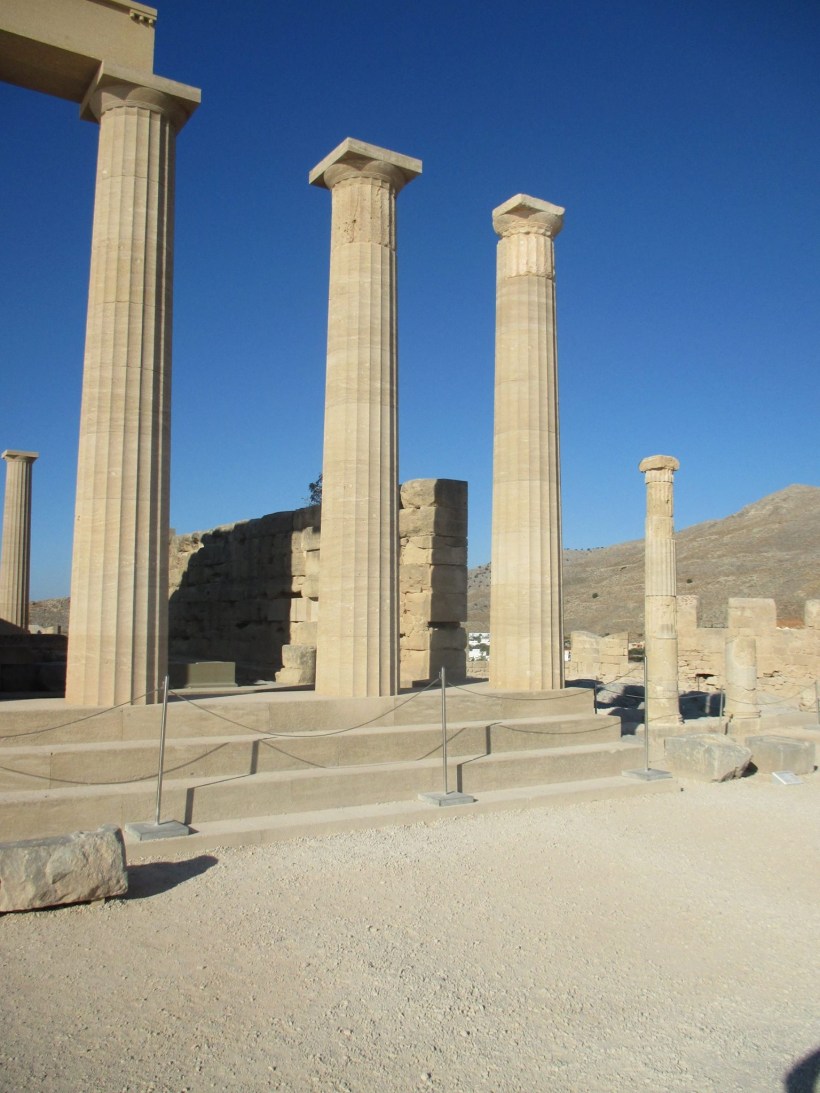
‘Today, less than half of the original 42 Doric columns remain, but their surprising resilience is more than enough to paint a picture of the magnificence of the stoa, which pre-empted the ascent to the Temple of Lindia Athena which crowns the plateau at the summit of the hill. The impact of the temple, set to the left of the plateau poised upon a dramatic sheer drop to the sea beneath, belies its relatively small size which, at some 72 feet in length and 26 feet wide, is considerably smaller than that of the stoa below. Built in the 4th Century BC, what can be seen today replaced a previous older place of worship, which was destroyed by fire in 392BC.
The honey-coloured, limestone Doric columns appear almost to grow from the dust, allowing them to blend in with this solemn place of contemplation. The columns that stand here now are mostly the result of restoration work originally done during the Italian occupation in the first half of the 20th Century.
That the Italians were often more concerned about making the grand gesture rather than strict authenticity has led to criticism of them by modern archaeologists, and the scaffolding, which is frequently a feature of the acropolis, alludes to a more thorough and wholesale restoration under the aegis of the Greek Ministry of Culture, which is a perpetual work in progress.’ 

The warship of Lindos

trireme .jpg

After climbing the medieval steps that ascend from the entrance to the archaeological site at Lindos, it is worth stopping at the first level where the magnificent carving of a Rhodian warship bears witness to the island’s maritime heritage. Although more recent than the Trojan Wars – dated around 180 BC – this relief of the stern of a trireme is believed to be the work of the sculptor Pythokritos and formed part of the base to a statue, which an inscription on the ship’s side tells us was of Admiral Agesander, son of Mikion.
Staring at the graceful, swanlike neck of the aft quarters of this galley it is easy to be transported back to the Peloponnesian War of the 5th Century BC where, as members of the Delian Confederation, Rhodes supplied ships for the Athenian fleet, before swapping allegiances to the victorious Spartans not long before their victory. Three tiers of oarsmen numbering some 160 could propel such ships more than 60 miles a day. They were used for ramming the enemy or transporting troops and supplies for land battle. In the true spirit of Athenian democracy of the time, they were not crewed by slaves, but by an assortment of free men either fulfilling their military service or paid hands. The ships would only travel by day and were of light enough construction to be beached by the crew overnight.

Monolithos

Monolithos .jpg

What is left of the castle stands upon the rock that gives this charmed spot its name mono lithos, meaning ‘lonely rock’. It can be reached by way of a narrow, steep staircase hewn out of the cliff face. Parking at the bottom of the crag we began the trek upwards. A lighter lunch might have been sensible, but the breathless hike to the top is worth it, not least to take a look around the ruined walls that encircle the remains of two small chapels and the cisterns, which would have provided for the basic needs of the garrison stationed here. The real reward for the climb, however, is the view. Beneath the vertiginous, 300-ft cliffs tiny, secluded beaches burrow into their secret coves. Out to sea, peeking through the heat-haze of breathless air, are two small islands moored offshore, and inland a lush pine forest floods the foothills of Rhodes’ second highest peak. Mount Akramytis rises some 2,700 feet above the tiny village glimpsed beneath us inland. The forest is so different from much of the landscape elsewhere on the island. It comes as a shock after the barrenness of the south from where we have just come.

In Rhodes Town

Rhode street .jpg

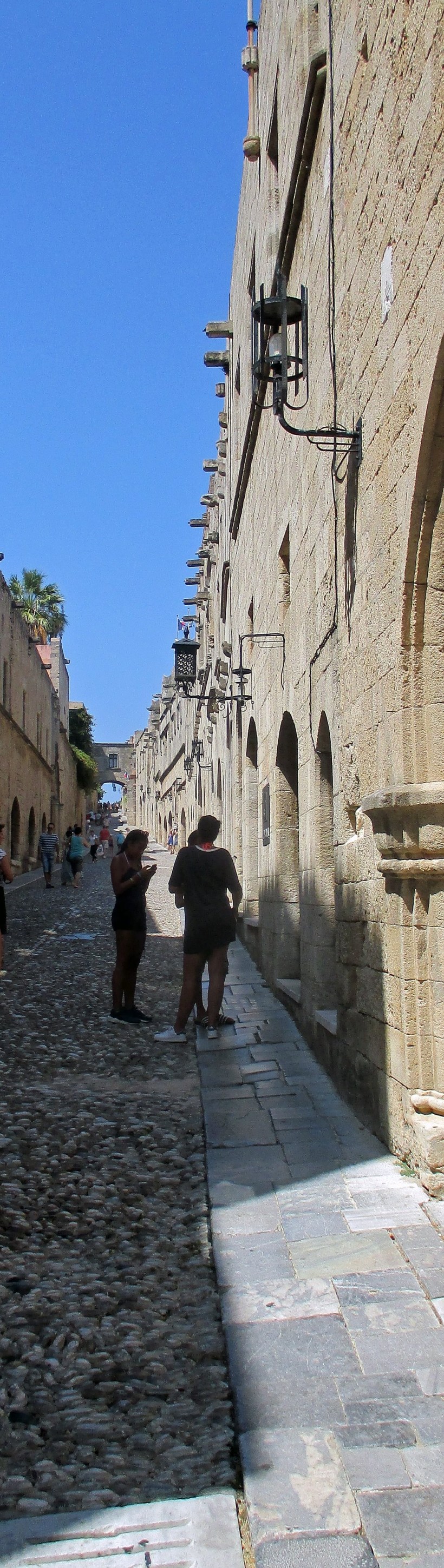
For most though there is plenty to satisfy here, and the architectural style that pervades at first would appear to be that of the Knights. But some of this is pastiche, the work of heavy-handed Italian ideologues trying to create a long forgotten chivalric era in the image of the crusaders. The Italian influence came crashing down under the marching heels of the jackboots of their erstwhile allies the Germans in 1943, an echo of the eventual capitulation of the Knights some four hundred years earlier to the Ottoman forces of Suleiman the Magnificent in 1522.
The folly of that ill-conceived Italian dynasty may have restructured parts of the town in a cold, stern idealisation of what they held to be medieval, but things could have been so much worse. To the untrained eye, the flying buttressed lanes of the original city segue effortlessly into the reconstructed facsimile and, in passing, it is difficult to see the joins.